

Solving equations#
Goals of this lesson#
Provide a quick overview of what we need to know in order to solve equations
Establish the necessary background for why we need ot use numerical solutions to equations
Finding a solution#
We have now seen the general form of several different equations we will be using to model geodynamic processes, such as the heat transfer equation below
but how do we go from this form of the equation to a solution in the form
A simpler example#
Let’s start simpler.
Steady-state heat conduction in one dimension (1D)#
where
Time dependence is represented by \(\frac{\partial T}{\partial t}\)
Advection is represented by \(v_{z} \frac{\partial T}{\partial z}\)
Conduction is represented by \(\frac{\partial}{\partial z} \left(k \frac{\partial T}{\partial z} \right)\)
Heat production is represented by \(A\)
In the case of steady-state heat conduction without advection or heat production, our equation simplifies considerably:
resulting in
In fact, we can even factor out the thermal conductivity \(k\) to yield an even simpler relationship:
Here we are thus left with simply the second derivative of temperature \(T\) with respect to depth \(z\). We can solve this! We just need to integrate twice with respect to \(z\).
A simpler example?#
We can integrate with respect to \(z\) once to find
noting both integration constants would be combined as \(c_{1}\).
A second integration yields
which can be rearranged to
OK, now what?#
OK, so we now have a solution, but we cannot calculate temperatures yet because we don’t know the values of \(c_{1}\) and \(c_{2}\), the constants of integration.
What do we need to be able to find \(c_{1}\) and \(c_{2}\)?
Boundary conditions#
By integrating twice we end up with two unknown constants.
In order to find the values of the constants, we need to use boundary conditions, known (or assumed) values for certain variables in our equation.
There are two natural choices for our heat transfer problem:
Known temperatures at certain depths
Known temperature gradients at certain depths
Let’s make some assumptions:
We know the surface temperature at \(z = 0\) is \(T = 0\)
We know the temperature at some depth \(z = L\) is \(T = 1000 ^{\circ}\mathrm{C}\)
If we substitute in assumption 1 we find \(c_{2} = 0\). If we substitute in assumption 2 we find \(c_{1} = -1000 / L\).
Now we can finally see our exciting result with \(c_{1} = -1000 / L\) and \(c_{2} = 0\)…
…a straight line.
Other considerations#
So that was an almost embarrassingly simple example
Heat conducted between two known temperatures at steady state will simply produce a linear temperature increase across the thickness of the material
What happens, though, if we consider a heat transfer problem that is not at a steady state?
What other information might we need to know for that case?
Initial conditions#
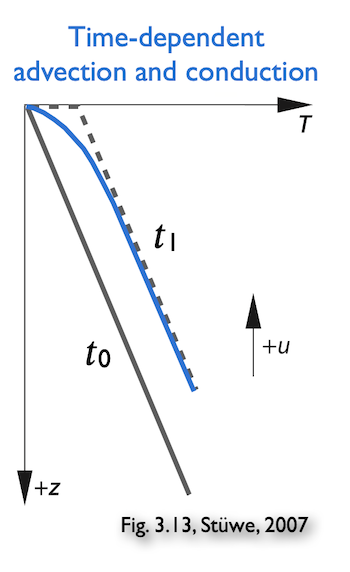
In order to consider the time evolution of the temperatures in the Earth, we would also need to know the starting distribution of temperature
This is known as an initial condition
Clearly, the temperatures we expect after some time can strongly depend on the initial conditions we assume
Why don’t we need an initial condition for the steady-state case?
What about other scenarios?#
What if we want to solve slightly more complicated problems?
2D heat transfer with surface topography
Spatially variable material properties
Temperature-dependent material properties
In most of these cases we cannot simply directly integrate our heat transfer equation because we cannot find the constants of integration.
Consider the example above with topography
We likely do not have a function that can give us the required known values of temperature and elevation at the surface
The need for numerical integration#
In cases where the geometry of the problem or material property distributions/behaviors are more complex, we need to use numerical methods to integrate our equations of interest
Much of days 2 and 3 in this course will focus on the finite difference method for solving equations, how it can be used, and its limitations.
The finite difference method is one of the most popular approaches used for solving equations in geodynamic models
We will start learning the details of the finite difference method tomorrow (Tuesday) morning
Summary#
To solve equations used in geodynamic modelling (or anything really) we need to know
Boundary conditions
Initial conditions (in some cases)
We can solve these equations directly in some cases, but most of the time we will need to use numerical methods such as the finite difference method to find solutions
References#
Stüwe, K. (2007). Geodynamics of the lithosphere: an introduction. Springer Science & Business Media.